Beyond Balance Sheet Forecasting
Rethinking ALM, behavioural assumptions and risk-adjusted decision-making
As interest rate cycles shift and customer behaviour becomes increasingly difficult to predict, banks face growing challenges in balance sheet forecasting, behavioural assumptions and risk management.
In this interview, we explore five critical questions shaping modern Asset & Liability Management (ALM) practices, from deposit behaviour and interest rate risk to scenario analysis and decision-making.
Burak Evren
Director, Financial Risk · Linktera

01. Forecasting balance sheets: which assumptions get it wrong?
When a bank updates its balance sheet forecast, which assumption most often turns out to be wrong six months later, and how do you see teams catching it?
If I had to identify one area, I would point to customer behaviour, particularly deposit pricing and balance retention assumptions.
Banks can build sophisticated interest rate scenarios, but correctly forecasting how customers will respond to changing rates is much more challenging.
For example, we may assume that deposit costs will decline at a certain pace following a policy rate cut. Six months later, competitive pressures or customer preferences may have resulted in a very different outcome.
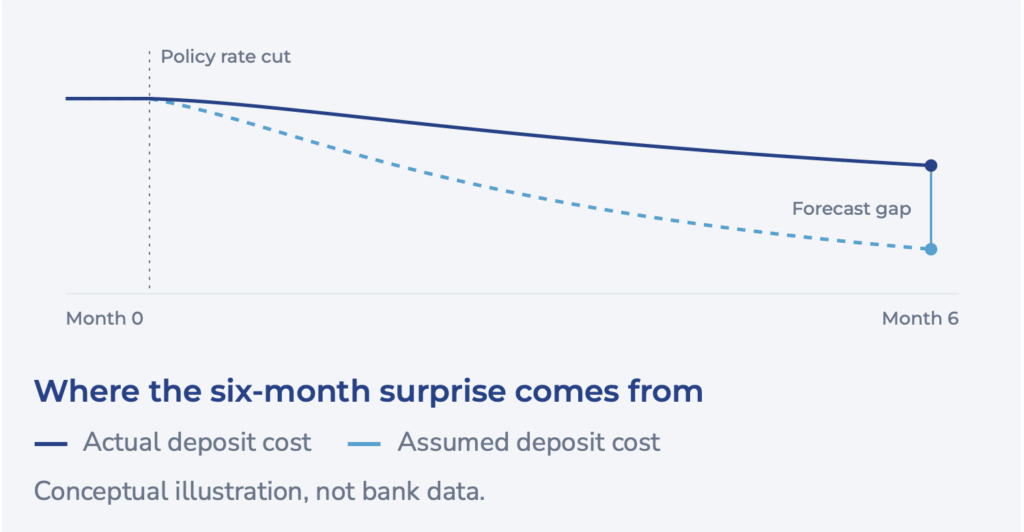
The key is not simply to update the forecast. It is to systematically compare projected and actual results, identify whether deviations come from pricing, volumes or customer behaviour, and recalibrate the relevant assumptions.
In my view, a good forecasting engine should not only tell us what may happen. It should also help us understand why our previous expectations were wrong.
02. ALM, FTP and product pricing: bridging the assumption gap
In the institutions you work with, do ALM, FTP and product pricing use the same deposit behaviour assumptions? Where does the gap usually open?
Ideally, they should be based on a consistent understanding of customer behaviour. But in practice, this alignment is not always achieved.
The gap often appears in the treatment of non-maturity deposits, particularly their stability, behavioural maturity and sensitivity to market interest rates.
ALM may use behavioural assumptions to project cash flows and measure interest rate risk. FTP translates funding characteristics into internal transfer prices, while product pricing also considers competition, commercial objectives and customer relationships.
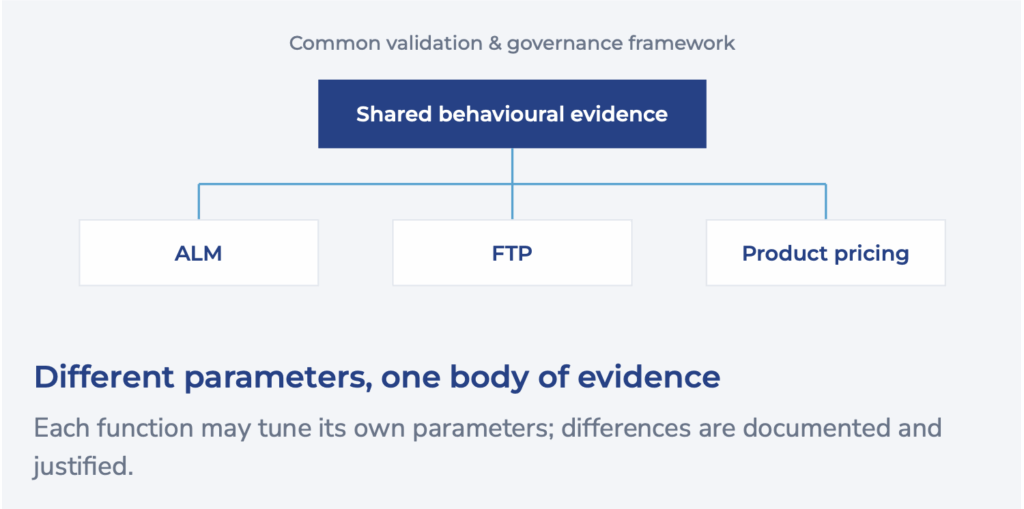
These are different purposes, so we should not necessarily expect identical parameters in every model. However, the underlying behavioural evidence should be consistent, and any differences should be clearly justified.
The real challenge begins when different departments maintain their own assumptions without a common validation and governance framework.
A bank should be able to explain why the same deposit behaves differently across its models
03. Navigating a declining rate environment
Policy rates in Türkiye and Kazakhstan started to fall in October. What is the first thing a treasury or ALM team should re-check when the rate cycle turns?
The first thing I would re-check is the repricing asymmetry between assets and liabilities, particularly the assumptions governing how quickly loan yields and deposit costs respond to declining rates.
A policy rate cut does not automatically translate into an equivalent reduction in banks’ funding costs. Competitive pressures, customer behaviour and contractual repricing structures can create significant differences.
For example, loan yields may decline relatively quickly, while deposit costs remain elevated because of competition for funding.
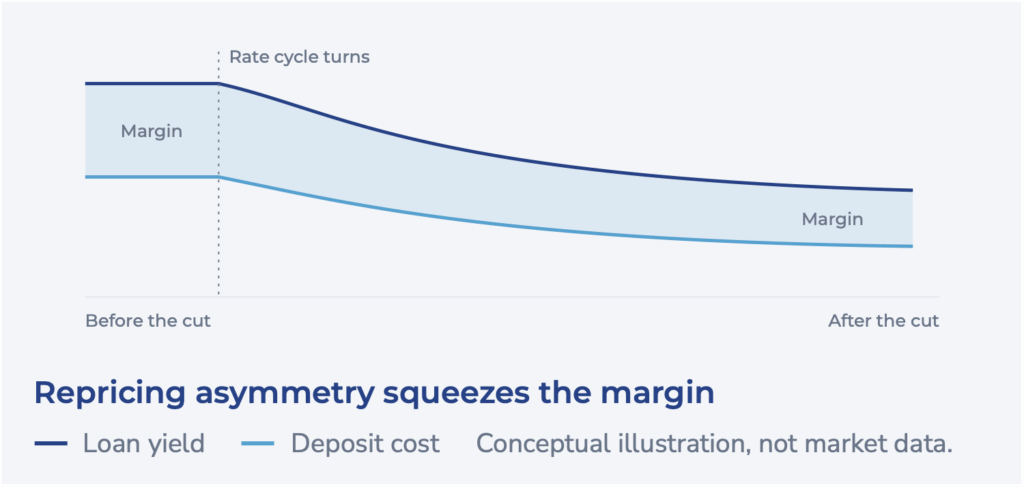
This could put pressure on net interest margins, even though the overall interest rate environment is becoming more accommodative.
I would therefore revisit deposit betas, repricing schedules, funding assumptions and prepayment behaviour, and run alternative NII scenarios.
When the rate cycle turns, the critical question is not simply how much rates will fall, but how differently our assets and liabilities will respond.
04. IRRBB management: beyond regulatory compliance
The Basel Committee says banks still show shortcomings in IRRBB management under the 2016 standard. From the field, which shortcoming do you see most often?
From my perspective, one of the most persistent weaknesses is the governance and validation of behavioural assumptions.
Many banks have developed the technical capability to calculate EVE and NII sensitivities under regulatory interest rate shocks. However, producing a regulatory number is not necessarily the same as having an effective interest rate risk management framework.
The real challenge is often in the assumptions behind those numbers: non-maturity deposit behaviour, prepayment rates, repricing characteristics and the way these parameters change under different scenarios.
These assumptions may be based on historical observations, but they are not always sufficiently challenged, independently validated or updated when market conditions change.
This is particularly important in volatile interest rate environments, where yesterday’s behavioural patterns may no longer be representative.
The challenge is not just measuring IRRBB accurately. It is ensuring that the assumptions driving those measurements remain credible and relevant for decision-making.
05. NII scenario analysis: from data to decision-making
How long should it take a mid-sized bank to run a new NII scenario from data to a decision-ready result, and what usually makes it take longer?
For a mid-sized bank with an established analytical infrastructure, I believe a new NII scenario should ideally become decision-ready within the same business day, and preferably within a few hours.
Of course, we should distinguish calculation time from the complete analytical process.
The calculation engine itself may run relatively quickly. What often takes much longer is preparing and reconciling data, adjusting assumptions, validating results and explaining the differences from the baseline scenario.
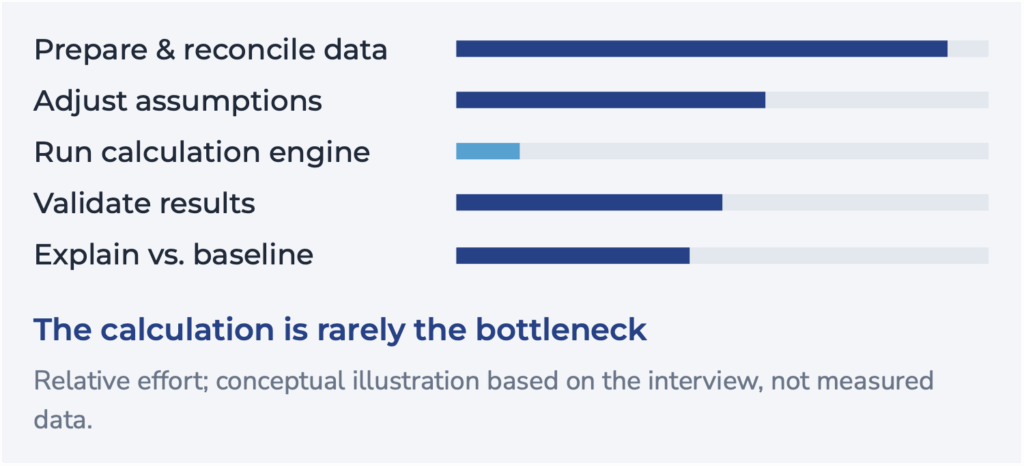
In my experience, fragmented data sources, manual spreadsheet interventions and inconsistent assumptions across departments can create more delays than the calculations themselves.
The objective should therefore be to automate the entire process — from validated data and scenario configuration to financial projections, comparison with the baseline and management reporting.
A scenario becomes valuable when decision-makers can act on it while the underlying business question is still relevant.