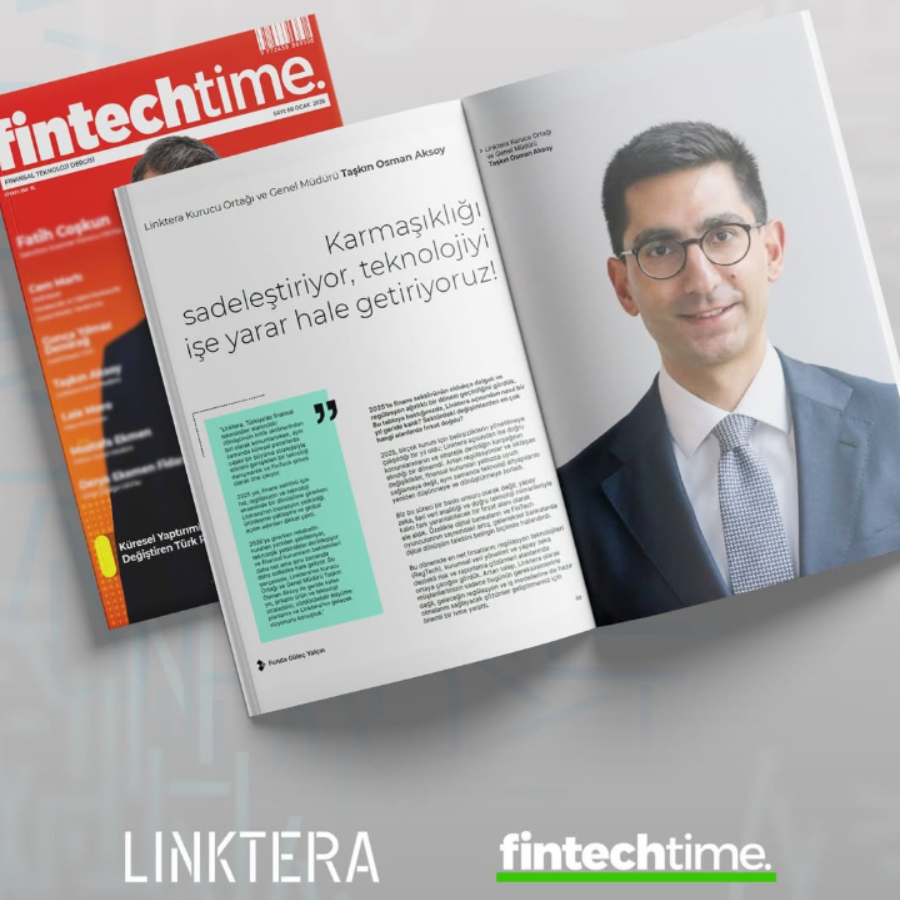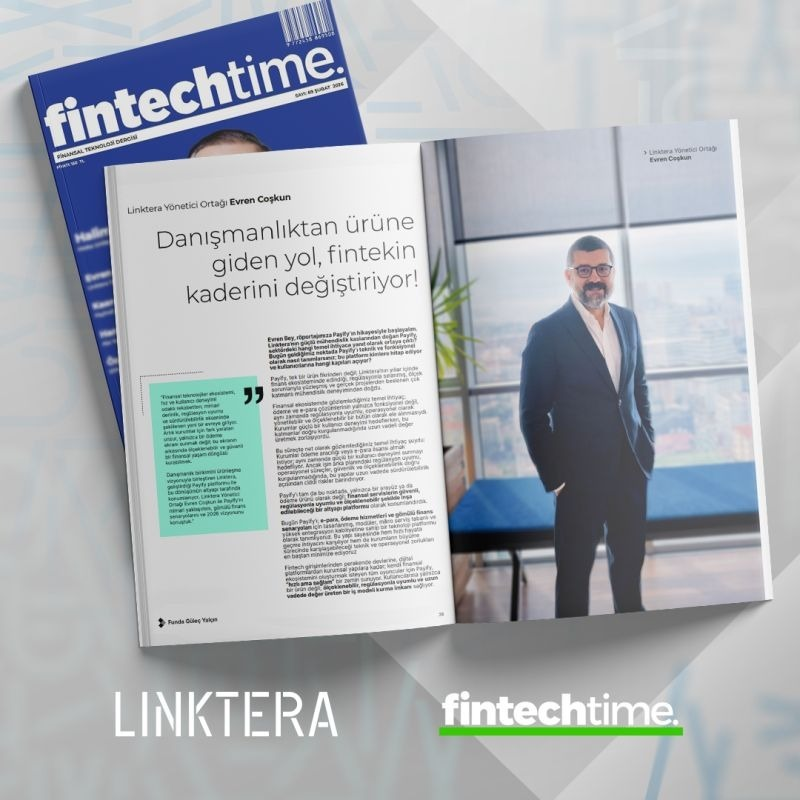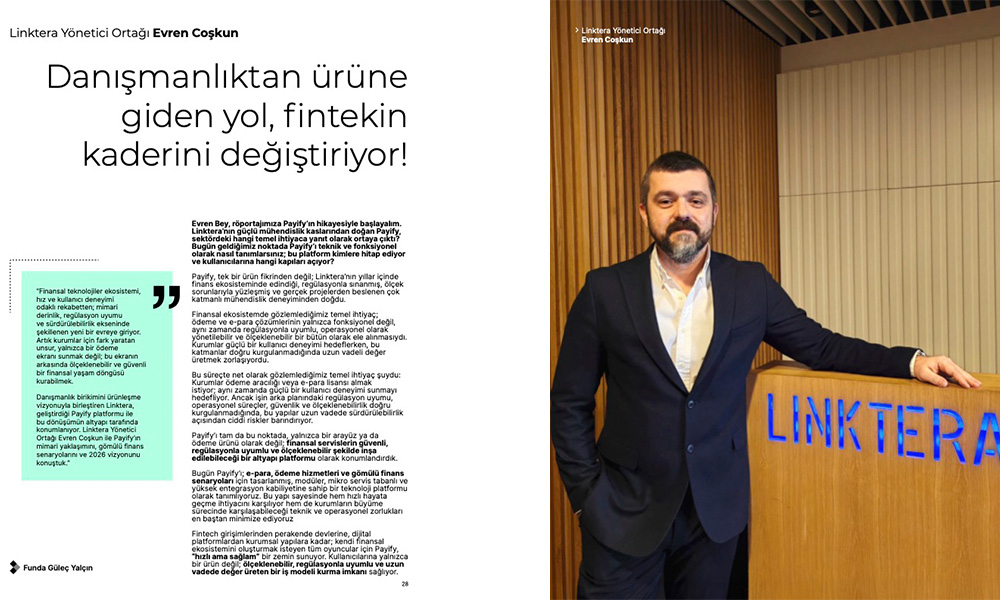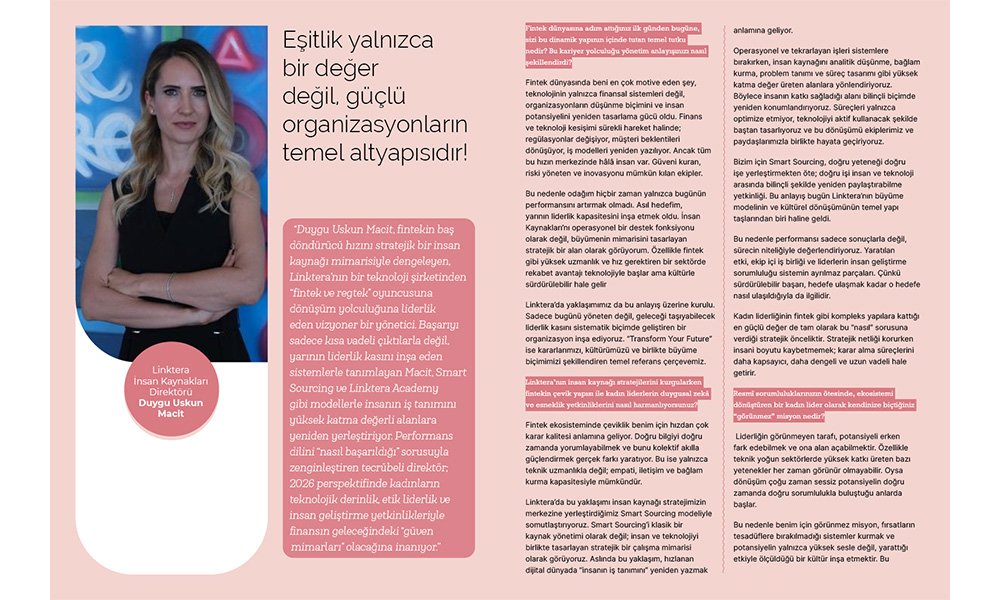
Our interview with Duygu Uskun Macit, Human Resources Director at Linktera, for Fintechtime’s March 2026 issue’s feature story “Architects of the Fintech World,” is now available.
“Duygu Uskun Macit is a visionary executive who leads Linktera’s transformation journey from a technology company to a ‘fintech and regtech’ player, balancing the dizzying pace of fintech with a strategic human resource architecture. Defining success not just by short-term outcomes but by systems that build the leadership muscle of tomorrow, Macit is repositioning the human role in high value-added areas with models like Smart Sourcing and Linktera Academy. Enriching the language of performance with the question of ‘how it was achieved,’ the experienced director believes that, from a 2026 perspective, women, with their technological depth, ethical leadership, and human development competencies, will be the ‘architects of trust’ in the future of finance.”
From the first day you stepped into the fintech world until today, what is the fundamental passion that has kept you within this dynamic structure? How has this career journey shaped your management approach?
What motivates me most in the fintech world is the power of technology to reshape not only financial systems, but also the way organizations think and the potential of their people. The intersection of finance and technology is constantly in motion; regulations are changing, customer expectations are evolving, and business models are being rewritten. But at the heart of all this speed is still the human element: teams that build trust, manage risk, and enable innovation.
Therefore, my focus has never been solely on improving today’s performance. My main goal has always been to build the leadership capacity of tomorrow. I see Human Resources not as an operational support function, but as a strategic area that designs the architecture of growth. Especially in a sector like fintech, which requires high expertise and speed, competitive advantage begins with technology but becomes sustainable through culture.
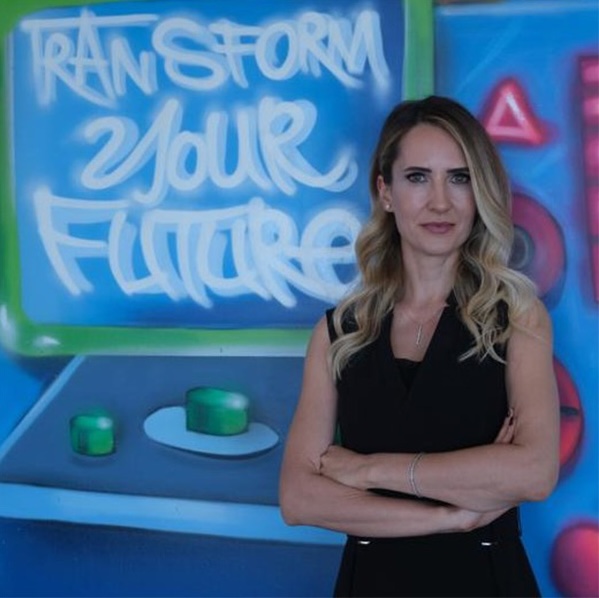
At Linktera, our approach is built on this understanding. We are building an organization that systematically develops the leadership muscle to not only manage the present but also carry the future. “Transform Your Future” is our fundamental frame of reference that shapes our decisions, our culture, and how we grow together.
When designing Linktera’s human resources strategies, how do you blend the agile fintech structure with the emotional intelligence and resilience skills of female leaders?
For me, agility in the fintech ecosystem means decision quality rather than speed. Being able to interpret the right information at the right time and strengthening it with collective wisdom makes the real difference. This is not just about technical expertise; It is possible with the capacity to empathize, communicate and establish context.
At Linktera, we concretize this approach with the Smart Sourcing model that we place at the center of our human resources strategy. Smart Sourcing is not a classical resource management; We see it as a strategic working architecture that designs people and technology together.In fact, this approach means rewriting the “job description of a human” in the accelerating digital world.
While we leave operational and repetitive tasks to systems, we direct human resources to areas that produce high added value, such as analytical thinking, context establishment, problem definition and process design. In this way, we consciously reposition the space in which people contribute. We not only optimize processes, we redesign them to actively use technology and implement this transformation together with our teams and stakeholders.
For us, Smart Sourcing is more than placing the right talent in the right job; The ability to consciously redistribute the right work between people and technology. This understanding has become one of the basic building blocks of Linktera’s growth model and cultural transformation.
Therefore, we evaluate performance not only by results but by the quality of the process. The impact created, collaboration within the team and the responsibility of leaders to develop people are integral parts of the system. Because sustainable success is as much about achieving the goal as it is about how that goal is achieved.
The most powerful value that female leadership adds to complex structures such as fintech is the strategic priority it gives to the “how” question. Not losing the human dimension while maintaining strategic clarity; It makes decision-making processes more inclusive, more balanced and long-term.
Beyond your official responsibilities, what is the “invisible” mission you have set for yourself as a female leader transforming the ecosystem?
The unseen side of leadership is recognizing potential early and creating space for it. Especially in technically intensive sectors, some highly contributing talents may not always be visible. Yet, transformation often begins when silent potential meets the right responsibility at the right time.
Therefore, for me, the invisible mission is to establish systems where opportunities are not left to chance, and to build a culture where potential is measured not only by its loud voice but also by its impact. I see this approach as a responsibility not only within our teams but also at the ecosystem level.
Linktera Academy, which we have implemented at Linktera in line with this vision, is a concrete reflection of this understanding. Beyond being a structure that develops technical competencies, it positions itself as a development platform that supports future technology leaders at an early stage.
We are extending this same approach beyond the boundaries of the organization. Establishing early contact with university students and recent graduates, connecting them with real problem areas, and preparing them for the sector with a strong perspective forms the foundation of a sustainable technology culture. Lasting transformation becomes possible with potentials that are supported and encouraged at an early stage.
This perspective also shapes our view of the role of women within Turkey’s Domestic and National Technology Initiative. I believe that it is impossible to build a sustainable ecosystem without ensuring inclusive growth in technology. Therefore, for the past five years, we have been working intensively with the Women in Technology Association, actively working to increase women’s representation in the technology sector.
Because leadership is not a position; it is a capacity that can be replicated. True success lies in building a leadership chain that extends beyond you and continues after you.
Was there an experience in your leadership journey that you would describe as a turning point?
One of the most important turning points for me was the strategic transformation Linktera underwent when I joined the company. It was a journey from a structure built on nearly ten years of strong consulting, service, and technology experience to a FinTech and RegTech company investing in its own products with the LinkteraLABS vision. This transformation meant not only a change in the business model but also a redesign of the organization’s way of thinking.
While success in consulting-focused structures is often measured by project outputs, the product development journey requires a long-term perspective, sustainable competencies, and a different human resource architecture. During this process, we created new role definitions, established team structures bringing together different areas of expertise, and designed entirely new career paths for our team members. From a Human Resources perspective, this was more of a strategic transformation management than an operational adjustment process, and it was also a significant leadership test.
This very process allowed me to reconsider the concept of success. When speed increases, short-term outputs become more visible; however, the true quality of leadership is measured by long-term impact.
This experience showed me that performance is not just about results; He taught us that leadership should be evaluated based on decision quality, responsibility for team development, and sustainable contribution.
Leadership is actually a matter of choice: the consistency of choosing the right thing, not the easy one. Merit only gains meaning within a consistent system. Resistance often arises not from change, but from uncertainty. Clarity and consistency build trust. The ability to maintain values-aligned decisions during difficult times is the true strength of leadership.
From a 2026 perspective, we see glass ceilings increasingly becoming perceptual barriers. How do you think this transformation is happening specifically in the fintech sector?
Today, the glass ceiling often arises not from visible barriers, but from expectation patterns and invisible norms. When leadership is equated with a particular style, the potential of profiles with diverse competencies may not be sufficiently visible.
However, modern leadership is no longer one-dimensional. Empathy, as well as analytical thinking, and ethical sensitivity, as well as strategic clarity, determine the quality of decision-making. Invisible barriers most often emerge at the stages of accessing opportunities and becoming involved in critical areas of responsibility.
Therefore, it is critical that leadership development and promotion processes are designed with transparent, measurable, and consistent systems. Perceptions change over time; however, unless systems are consciously established, transformation will not be permanent.
The increasing visibility of female leaders sends a powerful message to young professionals: There is no single right form of leadership.
How does having more women at the table affect organizational success?
Having more women at the table doesn’t just increase representation; it transforms the definition of leadership. Diverse perspectives balance risk assessment, make long-term impacts visible, and improve decision-making quality. In a risk-driven sector like fintech, this is a direct strategic advantage.
The real transformation, however, occurs in talent management. As diversity increases, a monolithic leadership model gives way to a multi-dimensional understanding of leadership. The definition of potential expands, different leadership styles gain value, and the organization creates a more inclusive development culture.
It’s not about numbers; it’s about enriching the organization’s capacity for thought.
What was the boldest step you took to make the management culture more inclusive?
Our boldest step was to move beyond simply representing and executing inclusivity at the level of discourse, and instead integrate it directly into the value creation mechanism.
One of the most concrete examples of this approach is the Idea to Product Program we implemented under LinkteraLABS…
This structure is not a classic “suggestion system.” It’s a true in-house entrepreneurship platform.
Our team members can submit their own product ideas through the Linktera platform. These ideas are evaluated based on strategic and technical criteria such as regulatory and industry compliance, technological feasibility, scalability, and the synergy they will create with the Linktera ecosystem. Projects that meet the criteria are included in the support program.
During this process, mentorship, technical team support, and business model design are provided; projects are systematically developed until the MVP stage. Products that reach MVP maturity are launched to the market through the Linktera ecosystem and receive end-to-end support, including sales, customer access, and operational support.
In this model, the idea owner is not a passive suggestion presenter; they become a stakeholder who designs the process and is responsible for the outcome. As the product develops, they can assume the role of product owner. When the company reaches the incorporation stage, it has the opportunity to be included in the partnership structure.
This approach fundamentally transforms the management culture. Because the individual is no longer just someone who fulfills a given task; they become a value creator, a risk-taker, and a true stakeholder in the resulting growth.
This is precisely where inclusivity gains meaning. It’s not just about giving people a voice; it’s about giving them the opportunity to be the true owner of the value created.
In the fintech world, sustainable innovation is possible not only through external investments but also by systematically unlocking internal potential. For us, inclusive leadership means opening up not just a career path for people, but an entrepreneurial space.
When we say “Transform Your Future,” we are saying it not only for our clients but also for our own ecosystem.
If you wanted to give realistic guidance to young women who want to pursue a career in fintech, what would you say?
The perception of a glass ceiling is sometimes fueled by real-life experiences, and sometimes by stories told. However, a career journey often begins with overcoming one’s own limitations before overcoming external obstacles.
Today, we live in the age of artificial intelligence, and in this new era, the most critical competency is the capacity for continuous learning. Having knowledge alone is no longer enough; professionals who can learn independently, build systems, and adapt quickly to changing conditions are the ones who stand out. Technical competence provides a strong foundation, but in the long run, the areas that make a difference are often skills that machines cannot take over: the ability to empathize, guide, build trust, and bring people together around a common goal.
I can say that a female leader I had the opportunity to work with early in my career was a true point of reference for me in this sense. Her approach to leadership was like a guiding star for me. Through that experience, I learned that leadership is not just about producing results, but about unlocking the potential of others. Encountering the right role models can shape one’s career path much more powerfully than expected.
Therefore, at Linktera, we offer training that goes beyond just technical orientation for both new and existing team members; We implement development programs that support continuous learning, internal team knowledge-sharing mechanisms, and regular “check-up” meetings. Furthermore, we prioritize a work environment where everyone can freely express their ideas, actively participate in decision-making processes, and continuously expand their areas of development.
Our goal is not only to ensure adaptation to the job; it is to build a sustainable development culture where everyone can consciously and systematically design their career journey. Because lasting success is only possible with teams where development is systematically supported and where everyone feels valued.
Opportunities often don’t come handy; they grow when demanded and responsibility is taken. Therefore, it’s not enough to just be good; you also need to learn how to make your contribution visible. Ask for feedback, take on challenging projects, and actively manage your development.
Because true transformation is possible only by systematically growing human potential. Our ‘Transform Your Future’ approach begins with individuals first taking ownership of their own potential.
What competencies define the “leading woman” profile in the fintech world after 2026?
I can summarize the profile of future female leaders with four concepts: technological depth, systems thinking, ethical leadership, and human development capacity.
Technological knowledge is no longer an advantage, but a fundamental requirement. In a world shaped by artificial intelligence and data analytics, leaders must understand the technical context. However, the real difference lies in being able to see complex systems holistically and predict their long-term impacts. Because fintech is no longer just about producing technology, but about building trust with technology.
Empathy, ethical awareness, and the ability to build trust determine the sustainability of leadership. High performance is only possible in psychologically safe, learning, and development-promoting organizations. Therefore, leadership is no longer just about providing direction; it means the ability to build systems that can scale potential.
Behind the fact that women are taking a stronger role in education, business, and leadership today lies a historical vision. At this point, I would like to especially express my gratitude to Gazi Mustafa Kemal Atatürk for his reforms that paved the way for women to be positioned as equal individuals in society. This path he opened is one of the strongest foundations for women leaders to boldly advance in the technology and fintech world today.
March 8th reminds us that equality is not just a value, but the fundamental infrastructure of strong organizations. The future belongs to leaders who can unlock human potential.