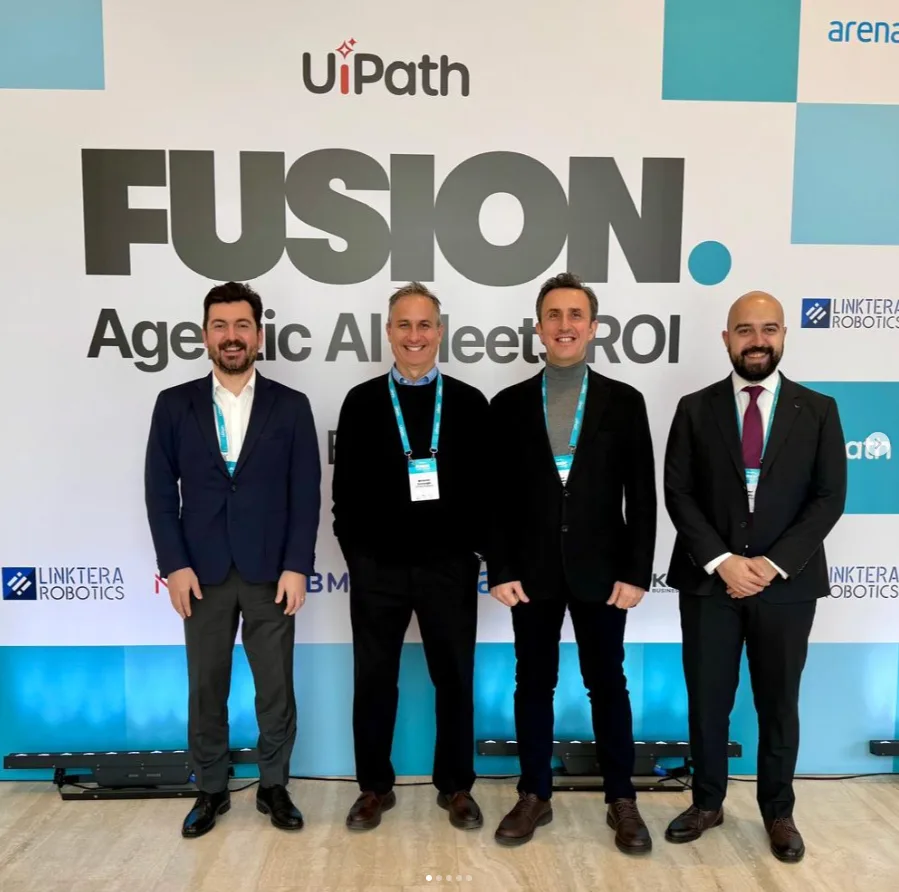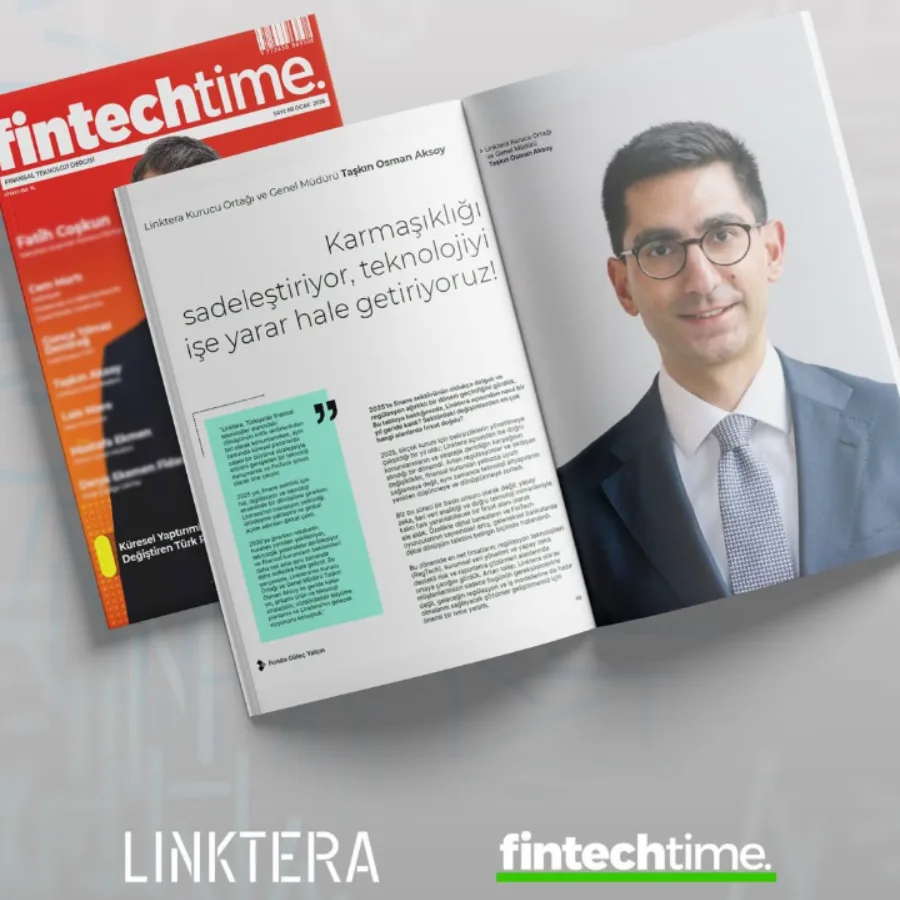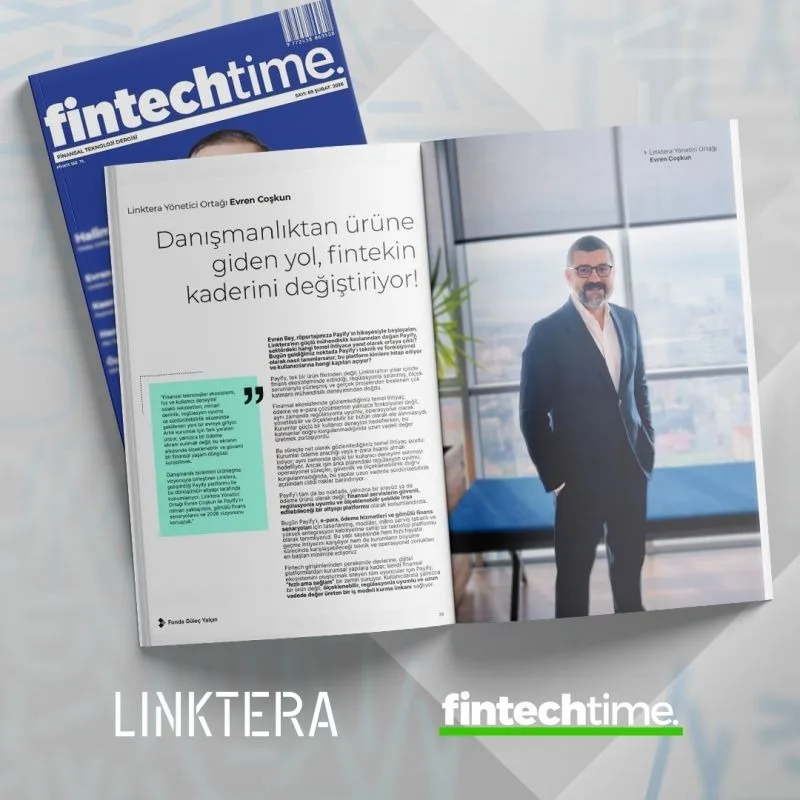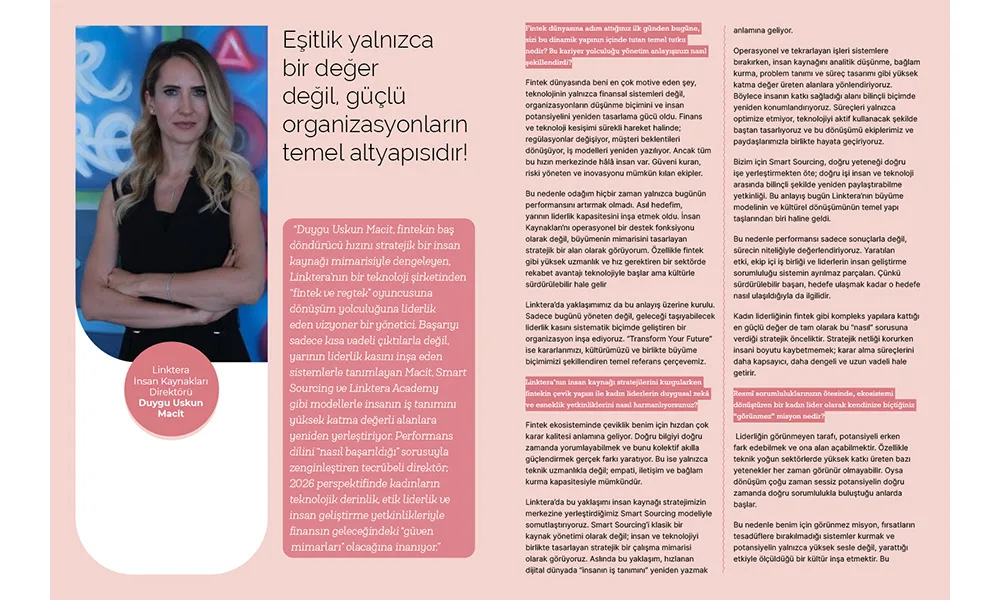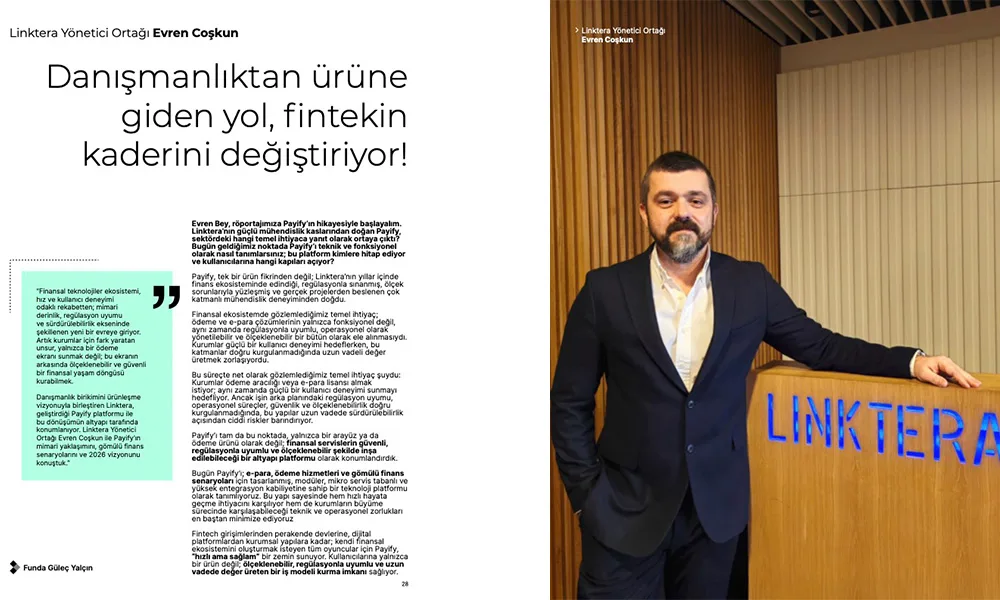
Our interview with Evren Coşkun, Managing Partner of Linktera, for the February 2026 issue of Fintechtime is now available.
“The financial technology ecosystem is entering a new phase, shifting from competition focused on speed and user experience to one shaped by architectural depth, regulatory compliance, and sustainability. The differentiating factor for organizations is no longer simply offering a payment screen; it’s about building a scalable and secure financial lifecycle behind that screen.”
Combining its consulting expertise with a product development vision, Linktera is positioned on the infrastructure side of this transformation with its developed Payify platform. We spoke with Linktera Managing Partner Evren Coşkun about Payify’s architectural approach, embedded finance scenarios, and 2026 vision.
Mr. Evren, let’s begin our interview with the story of Payify. Born from Linktera’s strong engineering capabilities, what fundamental need in the industry did Payify address? How would you describe Payify technically and functionally at this point; who does this platform appeal to, and what opportunities does it open up for its users?
Payify didn’t originate from a single product idea; it was born from Linktera’s multifaceted engineering experience gained over the years within the financial ecosystem, experience tested by regulation, confronted with scalability challenges, and nourished by real-world projects.
The fundamental need we observed in the financial ecosystem was for payment and e-money solutions to be considered not only as functional but also as a regulatory-compliant, operationally manageable, and scalable whole. While organizations aim for a strong user experience, generating long-term value becomes difficult when these layers are not properly designed.
The fundamental need we clearly observed during this process was this:
Organizations want to obtain payment processing or e-money licenses; at the same time, they aim to offer a strong user experience. However, if the underlying regulatory compliance, operational processes, security, and scalability are not properly designed, these structures pose serious risks in terms of long-term sustainability.
We positioned Payify precisely at this point not just as an interface or payment product, but as an infrastructure platform where financial services can be built in a secure, regulatory-compliant, and scalable way.
Today, we define Payify as a modular, microservice-based, and highly integrated technology platform designed for e-money, payment services, and embedded finance scenarios. This structure allows us to meet the need for rapid implementation while minimizing the technical and operational challenges organizations may face during their growth process from the outset.
From fintech startups to retail giants, from digital platforms to corporate structures, Payify offers a “fast but solid” foundation for all players who want to build their own financial ecosystem. It provides its users not just with a product, but with the opportunity to build a scalable, regulatory-compliant business model that generates value in the long term.
In Linktera’s overall vision, Payify is defined as ‘consulting expertise transformed into a product’. However, in the recent collaborations you’ve announced in the fintech sector, we see Payify not just as a technology product, but as an end-to-end ‘infrastructure solution partner’. With many wallets and payment infrastructures in the sector, what is the key factor that turns the tide towards you when brands sit down to negotiate with Payify? Where do you draw the line between ‘technology supplier’ and ‘strategic partner’?
What sets Payify apart is that it’s backed not only by strong software teams, but also by expertise in regulatory, operational, and business model consulting. Therefore, when we sit down with organizations, the conversation never stops at the level of “which module should we use?”. Our main focus is on collaboratively finding answers to questions like, “How do we scale this business model, where do we take risks, and where do we simplify to strengthen sustainability?”
For us, the line between a technology supplier and a strategic partner begins right here. Payify is not just a software provider; it positions itself as an infrastructure solution partner taking end-to-end responsibility, from installation and go-live to licensing, regulatory processes, and operational management.
While there are many wallets and payment infrastructures in the sector, the main reason why organizations turn to Payify at the decision-making stage is this holistic approach. Organizations are looking not just for a working technology, but for a business partner who thinks together on their growth journey, anticipates risks, and creates long-term value. Payify precisely meets this need.
Your collaborations frequently emphasize ‘scalable architecture’ and ‘operational efficiency.’ The support you provide, especially from the licensing process to product launch, is critical. Could you illustrate, through a concrete transformation story, how a startup or organization was able to implement a development project with Payify that would have taken years with their own teams, and how quickly they did so, eliminating significant operational burdens in the process?
For many organizations, establishing an e-money or payment infrastructure is not just a software development process; it’s a multifaceted journey encompassing regulation, operations, and organizational transformation. When handled internally, this process can often become a high-cost project with significant operational risks, taking 12–18 months. Licensing, compliance, security, and operational planning, in particular, require as much time and effort as, or often even more than, technical development.
With Payify, we are fundamentally changing this landscape. Depending on scope and regulatory requirements, we are transforming the journey from licensing to product deployment into a manageable structure within a few months. During this process, we are taking responsibility for organizations by:
- The burden of correctly interpreting and applying regulations,
- The responsibility for establishing the security and operational architecture, primarily in accordance with PCI DSS,
- We undertake complex infrastructure investments from the ground up for high-volume and scalable scenarios.
In concrete transformation stories, we clearly see this: Organizations that planned development over many years with their own teams can bring their product to market much earlier thanks to Payify. This is not just a time saving; it also means starting with a regulatory-compliant and scalable architecture without incurring technical debt.
As a result, organizations can focus their engineering and operational resources not on maintaining infrastructure, but on customer experience, business model design, and revenue-generating areas. This approach transforms Payify from simply a technology choice into a strategic leverage that directly creates a competitive advantage.
When we examined your website and product structure, we saw a wide range of modules, from Virtual POS and Digital Wallet to Bill Payment and QR code integrations. It’s frequently emphasized that Payify’s most important differentiator is its ‘customizable structure based on microservice architecture’. How does this technical architecture provide practical flexibility for your business partners? For example, how do you differentiate the needs of a retail brand’s loyalty-focused wallet from those of a fintech startup within the same infrastructure?
Payify’s microservice-based architecture offers partners flexibility based on a business model rather than a technical concept. We treat the infrastructure not as a single, uniform product, but as a structure that can be customized and reconfigured to meet different needs.
This approach allows different service sets to be deployed for different business models on the same core infrastructure. Organizations use only the functions that serve their own roadmaps; components they don’t need are left out of the process. When the business model changes or a new channel is added, it is sufficient to activate the relevant services instead of disrupting the existing structure.
This unbundling shortens time to market while also keeping operational and technical complexity under control during the growth phase. As a result, Payify offers organizations more than just an infrastructure that meets their current needs; it provides a financial backbone that strengthens as they grow, adapts as they change, and prevents strategic decisions from being delayed due to technical constraints.
In the world of payment systems, the concept of ‘Embedded Finance’ has now proven its worth. What role does Payify play in helping non-financial institutions (retailers, e-commerce, logistics, etc.) create their own financial ecosystems? For these brands, is Payify merely an interface for receiving payments, or is it a ‘growth engine’ that increases customer loyalty and revenue? How would you define the added value here?
Embedded finance is no longer a trend; it’s the new arena of competition. Payify positions itself not just as an interface that provides non-financial institutions with payment processing capabilities, but as a strategic platform that enables them to build their own financial ecosystems quickly, securely, and scalably. Our goal is to transform financial functions from an add-on to the core business into a natural part of the business model.
We view Payify not as a product offering individual integrations, but as an infrastructure that enables repeatable and sustainable embedded finance scenarios across different business models. Organizations can flexibly shape their payment, wallet, campaign, and loyalty structures on the same core infrastructure, in line with their own customer journeys and business goals.
Payify’s added value comes from not just offering the technology alone. The platform incorporates the expertise that enables these scenarios to be implemented in a regulatory-compliant, operationally manageable, and long-term scalable manner. Thus, financial functions cease to be an operational burden and become a growth engine that increases customer loyalty and generates direct revenue.
In short, Payify is not just a “payment recipient” for non-financial institutions; it offers a powerful embedded finance infrastructure that differentiates itself in today’s competitive environment and lays the groundwork for tomorrow’s business models.
The most sensitive point in the fintech world is undoubtedly security and regulatory compliance. Linktera’s experience in the ‘RegTech’ field is well-known. On the Payify side, how do you provide a ‘shield’ for your business partners in the PCI-DSS compliance and compliance processes with the Central Bank of Turkey/Financial Crimes Investigation Board regulations? How do you strike that delicate balance between speed and security?
Linktera’s experience in the RegTech field is one of Payify’s most important differentiating strengths and provides a significant layer of protection for our partners. PCI-DSS, CBRT, and MASAK compliance are not later-added checklists or project-based requirements on the Payify side; they are embedded in the architecture from the outset, treated as a natural part of the platform. This allows organizations to enter the market without having to bear the regulatory burden alone.
We view the balance between speed and security not as an “either/or” situation, but as two elements that must be designed together. Through automated compliance processes, clearly defined areas of responsibility, and a scalable security architecture, we enable rapid product deployment while preventing compromises on regulation and security.
Ultimately, Payify offers its partners not only a rapid launch opportunity, but also a sustainable financial infrastructure that grows stronger in terms of security and compliance as it expands.
Looking at Linktera’s 2026 strategies, the goal of ‘deepening product capabilities rather than aggressive expansion’ stands out. Within this deepening strategy, what new features or integrations are included in Payify’s roadmap specifically for 2026?

Since entering the Turkish electronic money and payment systems market, we have viewed Payify not merely as a technology product, but as a payment technology platform offering technical expertise, regulatory compliance, and operational maturity. This approach forms the basis of our 2026 strategy.
Instead of aggressive expansion, we are adopting a growth model that deepens product capabilities, is regulatory compliant, and generates value in the long term. Our priority is to make the existing infrastructure of institutions using Payify more secure, predictable, and efficient.
In this context, our 2026 roadmap includes AI-powered fraud prevention mechanisms and advanced risk scoring systems that analyze transaction behavior. Offering all these capabilities within a regulatory-compliant and operationally manageable framework is a critical priority for us.
In short, Payify’s 2026 focus is not on rapidly expanding into new markets, but rather on deepening the infrastructure that enables existing business partners to develop more secure and sustainable financial products. This approach makes Payify a predictable and robust technology partner for institutions.
Payment systems are increasingly becoming ‘invisible’. As a Managing Partner at Linktera, what fundamental advice would you give to companies looking to build their own payment ecosystem in 2026 and beyond? Will the winners of the future be those who buy technology, or those who combine it with the right business model?
For companies looking to build their own payment or financial ecosystem in 2026 and beyond, the most fundamental advice is to treat technology not as an acquisition, but as an integral part of their business model. In markets like Turkey, where regulation is strong and competition is rapidly intensifying, this approach is no longer a choice, but a necessity. Looking at the global scale, we see that successful examples are built on scalable and flexible infrastructures that can adapt to different markets.
As payment systems become increasingly invisible, the differentiating factor isn’t the interfaces themselves, but the strategic design behind them. How you manage data, how you design customer interactions, and how you scale this structure in compliance with regulations determine the differentiation between companies.
Therefore, the winners of the future will not only be those who use the latest technology, but also those who can combine technology with the right business model, the right market, and a sustainable growth strategy.
We know that Payify aims for ‘impact-focused’ and ‘sustainable’ growth rather than quantitative growth. Expanding on that vision and looking at it from a 5-year perspective, where is your ‘North Star’ for Payify? Is it to become a regional powerhouse emerging from Turkey, or to transform into a game-changer, a ‘Unicorn’, in the global fintech arena? Where do you envision Payify at the end of this story?
For Payify, the North Star is not about quantitative growth, but about becoming an infrastructure platform that creates lasting impact and sets standards in the sector. Our goal is to transform the technological and operational expertise we have gained in Turkey into a fintech infrastructure that first generates value on a regional scale, and then becomes a benchmark in global markets.
In this journey, our focus is not on rapid and uncontrolled expansion, but on deepening our focus on reliability, scalability, and sustainability. Becoming a unicorn is not a goal in itself for us; it is a naturally achievable result with the right business model, robust technology, and long-term value creation.
Ultimately, we see Payify as a platform that sets the rules of the game with its flexible architecture, regulatory compliance, and the impact it creates, and is referenced not only by its users but also by decision-makers in the sector. For us, success is measured by impact rather than size; by permanence rather than widespread adoption.